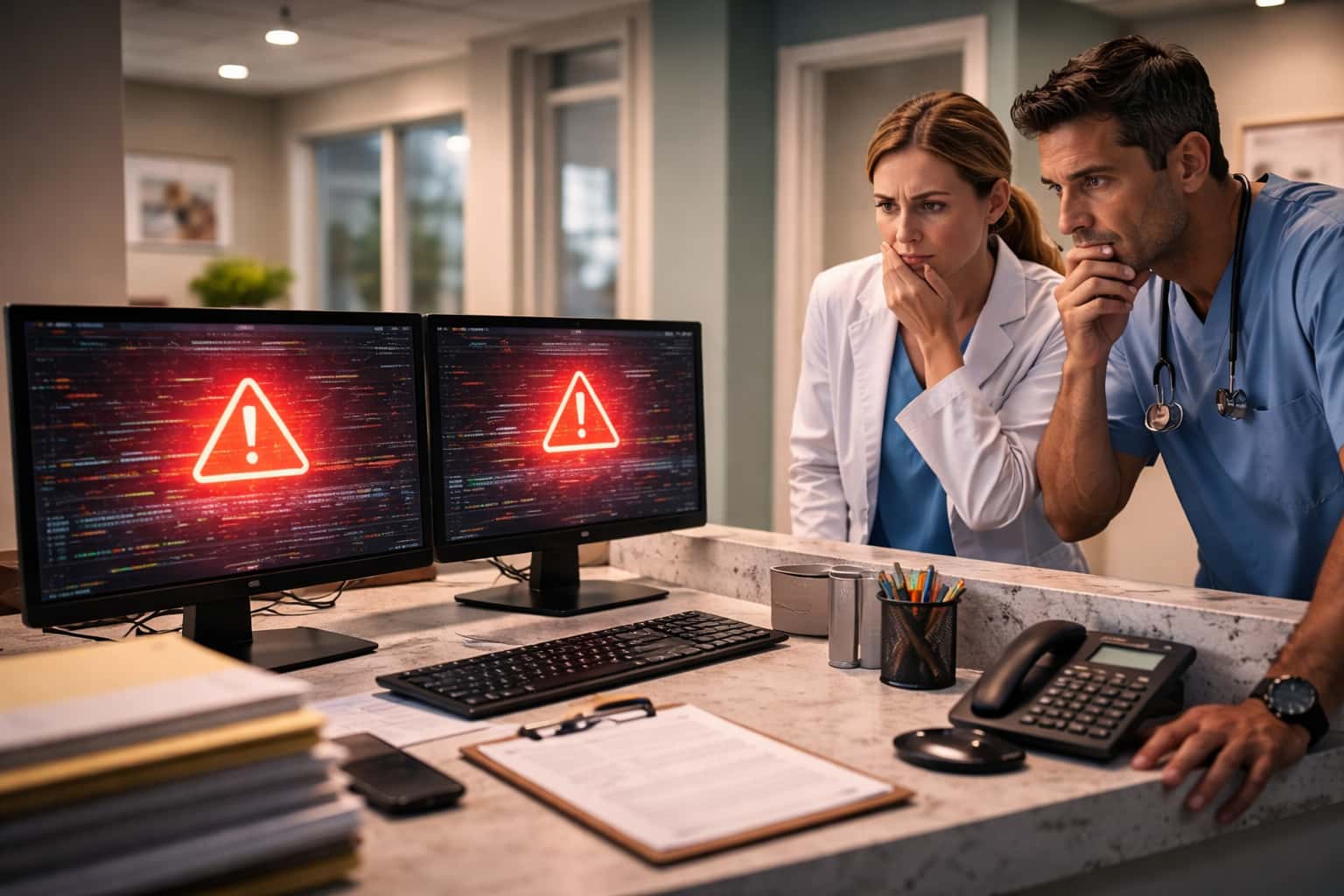
Ransomware is not a hypothetical threat for medical practices in Florida. It is happening right now, to practices just like yours, in communities just like Ocala. Understanding what a ransomware attack actually looks like — from the moment it begins to the months of recovery that follow — is the first step toward making sure it never happens to your practice.
The Attack Begins Before Anyone Notices
Most ransomware attacks do not start with a dramatic takeover. They start with a single employee clicking a link in a convincing phishing email — often disguised as a message from a vendor, insurance company, or even a patient. Once that click happens, the attacker gains a foothold in your network and spends days or weeks quietly mapping your systems, harvesting credentials, and disabling your backups before encrypting a single file.
Anatomy of a Ransomware Attack
What Gets Encrypted
Everything. Patient records in your EHR system. Scheduling databases. Billing and insurance claim files. Digital imaging archives including X-rays and diagnostic scans. Accounting records. Employee files. Every document on every shared drive and every workstation connected to your network. Modern ransomware is designed to find and encrypt everything of value — and to destroy or encrypt your backups so you cannot simply restore and move on.
The HIPAA Dimension
A ransomware attack on a medical practice is automatically considered a HIPAA breach. That triggers mandatory breach notification requirements — you must notify every affected patient, the Department of Health and Human Services, and in many cases the media. Penalties can range from $100 to $50,000 per compromised record, with annual maximums reaching into the millions.
Under HHS guidance, ransomware encryption of protected health information is a presumed breach. Your practice must notify every affected patient, HHS, and potentially the media within 60 days. There is no exception for practices that pay the ransom or recover their data.
The Difference IT Management Makes
| Category | Without IT | With Proactive IT |
|---|---|---|
| Detection Time | 197 days average | Hours |
| Recovery Time | 21+ days if possible | 4–8 hours from backup |
| Data Loss | Complete in many cases | Minutes to none |
| HIPAA Exposure | Full penalty exposure | Documented compliance |
| Total Cost | $254K+ recovery cost | $5K–$15K IT investment/yr |
| Business Impact | 60% close within 6 months | Minimal disruption |
What Could Have Prevented It
The painful truth is that most ransomware attacks on medical practices are preventable with standard security measures. Multi-factor authentication on all accounts. Advanced email filtering. Business-grade endpoint security. Regular, tested, offsite backups. Security awareness training. Network segmentation. These are not exotic technologies — they are the baseline of responsible IT management for any healthcare organization.
Most ransomware attacks on medical practices are preventable with standard security measures that cost a fraction of what recovery costs. The question is not whether your practice can afford proactive security — it is whether your practice can survive without it.
Simply IT has helped medical practices across North Central Florida recover from ransomware attacks and implement the layered security that prevents them from happening again.
Read the Case Study →
Steve Condit founded Simply IT to bring enterprise-grade IT management to small and mid-sized businesses across North Central Florida. With over 30 years of IT experience and a background in the US Marine Corps, Steve built Simply IT around the principle that local businesses deserve the same quality of technology partnership that large companies take for granted — without long-term contracts or national call center support.